
A saint who came from the sea
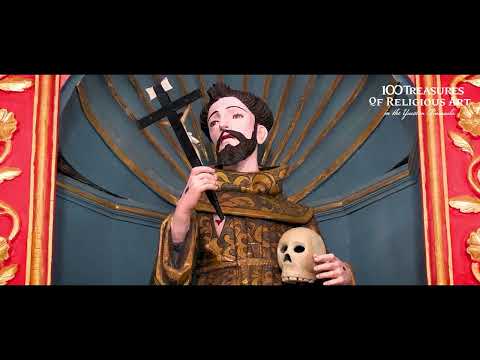

His demeanor serene as he contemplates the crucifix in his right hand, St. Francis of Assisi presides over the main altarpiece in the eponymous parish church in Telchac Pueblo.
Although the date of manufacture is unknown, the stylistic features characteristic of Baroque imagery appear to date it to the 18th century. The venerated statue, made of polychrome wood, seems to be European in origin.
The statue has deep religious significance for the townspeople, who set great store by the antiquity of the revered sculpture.
Local oral tradition recounts that the statue was found long ago on the beach at a nearby fishing village also called Telchac, together with two other images. When they tried to remove them from the beach, people noticed that the statue of St. Francis seemed far too heavy to be moved, except by the residents of Telchac Pueblo, who had also arrived. So everyone realised this meant that the saint wished to be taken to the latter village.

The statue shows St. Francis dressed in a richly decorated habit, with stigmata on his hands and feet. He walks slowly while gazing at the crucifix in his right hand, his forearm bent. In his left hand he holds a skull. All of these details give a sense of movement to the carving.
The statue stands in the central niche of the main altarpiece, and can be viewed during times when the church is open.
The patronal festival of St. Francis is celebrated on the 4th of October every year, with both religious and popular events.
Telchac Pueblo is located 53 kilometers (33 miles) northeast of Merida. It has the same Maya name as a fishing village 68 km (42 miles) northeast of the capital. To differentiate between them, one is referred to as “Pueblo” and the other as “Puerto”..
The etymology of the name Telchac is not precise: The Popular Maya-Spanish Dictionary suggests it refers to the long, thick roots of trees that frequently extend along roadways, while the Yucatan State Government webpage states that it means “necessary rain or water”, from tel, a contraction of teel, necessary or indispensable, and chac, which is a contraction of chaac, rain or water.
Location